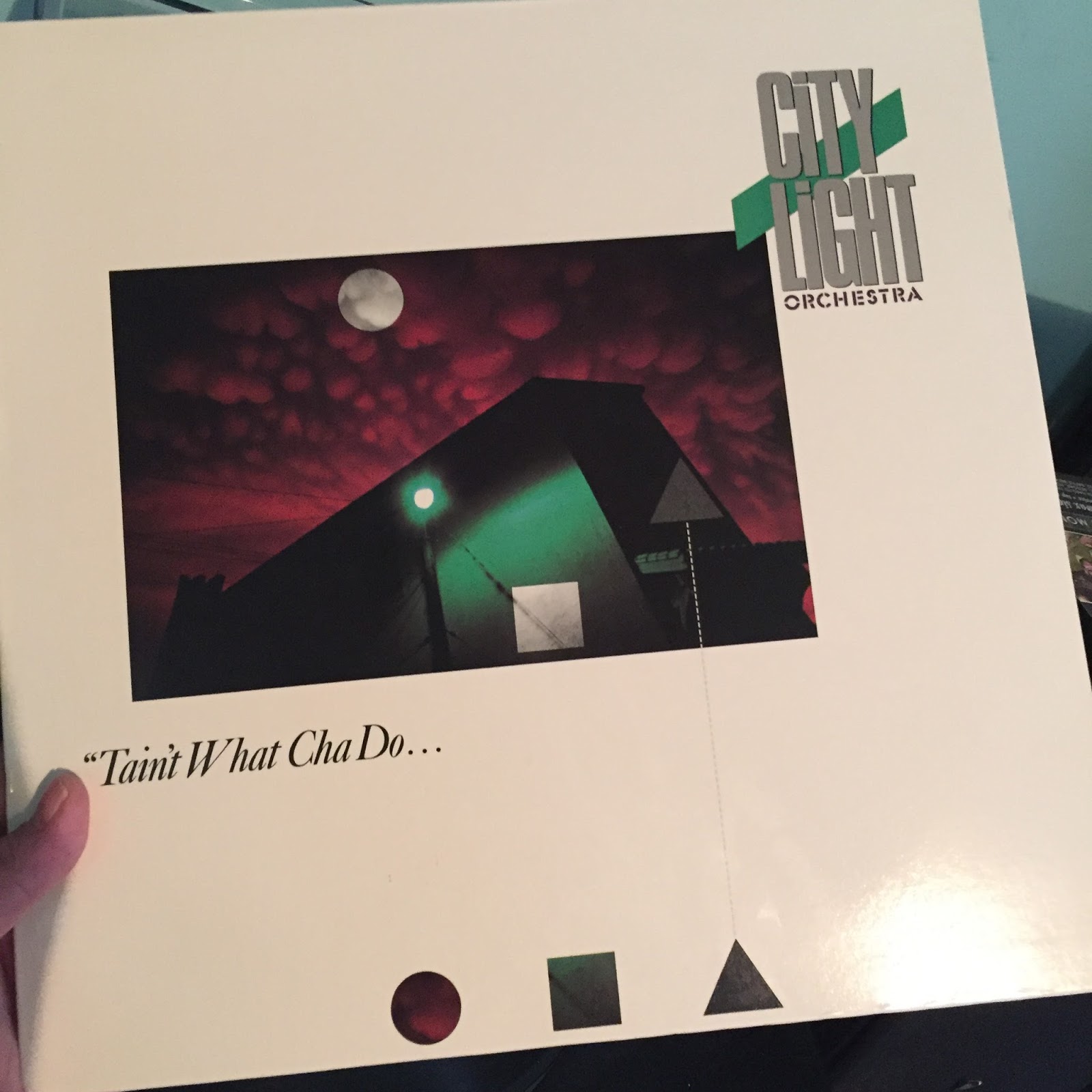
City Light Orchestra "Tain't What Cha Do City Light Records 1985 CAT# CL102
I thought I had discussed multiple City Light Orchestra releases by this point, but apparently, only just one (Light Orchestra). Looking at that release, appears they were using the moniker the Light Orchestra, but by this release, changed to City Light Records.
Like the prior, this is surprisingly good. I dig the vocalist, David Basse, who has a rough delivery. He's not a perfect singer, but his gimmick works. He's likely trying to channel some Louis Armstrong, but sometimes he has enough gravel in his voice to remind you of a cleaned up Tom Waits.
The album does suffer from some stylized production typical of the 1980's. When it goes that direction, it's loses it's appeal, becomes more about style than it does jazz. Oddly, the group traveled to Cerrillos, New Mexico to record the album, for a Kansas City based jazz group, but whatever floats their boat. Also, the cover would never give anyone the idea this is a jazz LP, cover makes you think terrible new-wave.
David Basse, still making the rounds, apparently
Vinyl record releases, 45s & LPS, local to Kansas and the surrounding Kansas City Area Metro area. Archived and discussed.
Showing posts with label KC Blues. Show all posts
Sunday, March 6, 2016
Friday, January 15, 2016
Queen Bey Comin' Thru Beystring Productions 1987
Queen Bey Comin' Thru Beystring Productions 1987 CAT# CAP122
Beyonce ain't got nothing on Kansas City, we had the original Queen Bey. Nice, right?
Queen Bey was a Kansas City blues and jazz singer active in a Kansas City scene that was popping out local LPs and compilations throughout the 80s. She's now in Los Angeles apparently or was, either way, it appears she still performing. This specific recording was recorded in Los Angeles and credited to Beystring Productions in Overland Park, KS. It can be assumed that Beystring was the Queen's own private label.
During her time in KC, she is reported to have started singing at an early age in the 1950's. Her bio indicates she started to become a significant member of the local jazz and blues scene in the 80's and is officially recognized as an Ambassador of Jazz for Kansas City. In addition to her singing career, she's also been featured as an actor in television, screen and on Broadway. So, a pretty substantial career.
This 5 song EP is a throwback sound, the backside notes it was recorded live with no mixing, editing or overdubs on a two tracks, so no plastic, canned garbage to be found here. It was recorded digitally, which was still fairly new in the 80s, so the sound is very sharp and loud, maybe too much, but that's a minor issue. It's an enjoyable set of songs with a throwback style. It certainly doesn't sound as if its a product of the 80's. However, someone could mistake for a 70's lounge act very easily if they weren't paying much attention. However, the arrangements done by Joe Cartwright and Greg Eicher (both Kansas City area guys) sound authentic to a time when jazz was king. Overall, it's a solid set of tunes.
Queen Bey Live, 2011 in KC
Thursday, January 7, 2016
Various Artists Atlantic Jazz Kansas City Atlantic 1986
Various Artists Atlantic Jazz Kansas City Atlantic 1986 CAT# 81701-1
There are numerous KC Jazz comps out there all of which are good, but this one does a tremendous job showcasing Kansas City as a pioneering city in music. The back liner notes do a much better job than me, but it takes all the artists featured here and connects the dots. From Buster Smith showing up from Texas, Basie from Ohio, and McShann coming from Oklahoma, they all met and played together in Kansas City. They also crossed paths with Charlie Parker. And just as soon as they hit upon a Kansas City sound, they took it nationwide.
What you have hear is the Atlantic Records story of Kansas City. The swing that would transform jazz. The same artists who featured a young Charlie Parker before he revolutionized the genre. And the jump blues performed by Big Joe Turner that would eventually lead others to rock n' roll and be heard in soul records. It's not the complete story, but the selections here are all amazing and tell some of the best parts to it.
Jay McShann Jumpin' At the Woodside
Tuesday, April 7, 2015
Ida McBeth Now, Here It Is Me Muzik Unknown Year
![]() |
| Ida did her best to make this a one of kind item, but Glenda is a bitch and gave this to Goodwill. |
This album, based on cover and back sleeve photos, came out in the mid-80s. Looking at a lot of big hair and Miami Vice fashion on the backside. The music is drenched in slick 80's production as well, but, it's surprisingly in touch with KC jazz roots.
Rather than be corny and cliche, the covered songs are rework themselves into a classic jump blues style with a few torch numbers to showcase Ida's softer side. Her voice is strong and can fill a room with ease. The blues numbers are the albums strong point as their nod to history is surprising as based on the cover, you'd expect some sort of slick, 80's female pop-soul LP.
The production is credited to Ida McBeth. She exposed herself to the music scene at an early age moving to Los Angeles and singing in clubs. Apparently there's a 70's album she recorded, but there's no indication on her website that it was ever released. Either way, competent performances from all players and Ida's voice makes it a worthwhile listen. Nothing mind blowing, but strong for a local release. Today, she can still be found recording and performing locally.
Performing recently on the Plaza
Labels:
12",
Ida McBeth,
jazz vocal,
Jump Blues,
Kansas City,
KC Blues,
KC Jazz,
LP,
Me Muzik
Sunday, December 14, 2014
Tom Bark Cosmopolitan Redskin Leprechaun Records 1977
Tom Bark Cosmopolitan Redskin Leprechaun Records 1977 CAT# MON 1977 711 x 53
I can find more info about the guys Tom Bark associated than I can find about the actual composer of the album. Apparently, in the early days of rock n' roll Tom Bark was hanging out with the crowd surrounding Larry Emmett & The Sliders, which was an early rock n' roll band in the area. If you couldn't figure it out by the album cover, Tom Bark is Native American as was Larry Emmett. I believe the two formed a somewhat well-known band originally called Colt 45, but later renamed the KC Blues Band in the early 70's. That band stayed together loosely up until recent times.
Stepping away from the KC Blues Band, Tom Bark cut this album in 1977. It sounds very 1977. The production is slick and gives the LP a dated sound. The albums sound is all over the place, which doesn't give Bark much of an identity. He does some modern blues numbers, country tunes, and with KC gunslinger Terry Swope on guitars, he even borders on hard rock/heavy psych for an ending of a tune.
Bark is best when he focuses on his country rock leanings. The sound doesn't feel forced and the production serves it better. The country waltz of "Wandering Pollyanna" is a highlight. You'd think the label, Leprechaun Records, is a private thing, but they had at least one other release in the 80's and there are possibly other releases out there. The label was located in Kansas City, MO.
Two tracks with terrible sound quality
Tuesday, December 2, 2014
The Original Boogie Woogie Piano Giants Original Recordings 1938-1941 Columbia 1974
The Original Boogie Woogie Piano Giants Original Recordings 1938-1941 Columbia 1974 CAT #KC 32708
This is compilation featuring Chicago pianists Albert Ammons and Meade Lux Lewis, but it's full of Kansas City's Pete Johnson. It was released by Columbia as part of a John Hammond blues reissue series. Pretty solid to be thrown up with those names and shows that KC was a big deal. And, to have John Hammond credit Johnson is appropriate as he led the blues revival scene back in the day with his love of the blues.
The compilation has 9 tracks that feature Johnson on the piano. He dominates the LP. A number of tracks feature Big Joe Turner, but Johnson is found here working with the other mentioned names as well as solo on the defining track, "Boogie Woogie." He's clearly defined as one of the primary influences and inventors of the boogie woogie style.
The compilation took the original tracks, possibly from old 78s as you tend to hear surface noise throughout most tracks that sounds as if it was recorded in and original masters if they available. All tracks are presented in original mono and it appears the only hard work came in the transfer. There doesn't seem to be remastering job, just an attempt to get these as close to the original issues as possible. Solid pick up on the cheap due to the quality of the tracks, both Johnson's and others.
Pete Johnson Boogie Woogie
Sunday, July 20, 2014
Joe Williams with Count Basie and His Orchestra Everyday I Have the Blues Roulette 1959
Joe Williams with Count Basie and His Orchestra Everyday I Have the Blues Roulette 1959 CAT# R52033
I love these Basie/Williams albums. Mostly because for the rest of his life, Joe Williams spoke so highly of Count Basie. One of his early solo albums, he's quoted gloating about his work with Basie, then later performances, everywhere, always just gave huge thanks and credit to Count Basie. He never forgot his roots.
This album is in all actuality considered a solo LP for Williams. Joe Williams' popularity had reached it's peak. Williams' popularity was also instrumental to Basie's continued success. Basie's work on the album was a thank you to Williams for the years served as his band's singer.
Basie worked the arrangements with a smaller backing band than normal. You still get the huge sound expected from Basie's standard and title track, "Everyday I Have the Blues." However, after that, the album is laid back. The swing style of "Going to Chicago" is a vocal workout for Williams with your basic club group from Basie. The album flows like that for the most part, even a smoker like "Shake, Rattle and Roll" is toned down (but at a good clip, for sure). It's a jazz vocal album that finds Williams showing off and Basie adding flourishes that don't normally appear on similar albums.
Everyday I Have the Blues
Labels:
12",
1959,
Birdland Series,
Kansas City,
KC Blues,
KC Jazz,
LP,
Repress,
Roulette
Wednesday, July 2, 2014
Count Basie & Joe Williams Count Basie Swings Joe Williams Swings Verve/Polygram 1955
Count Basie & Joe Williams Count Basie Swings Joe Williams Swings Verve/Polygram 1955 Japanese Press CAT #825 770-1
Pretty incredible album. It was the first of several albums Basie did with blues singer, Joe Williams. Basie had quite a string of discovering amazing vocal talent and Williams was no different. Williams was born in Georgia, but spent most of his youth in Chicago, so outside of Basie, he has no Kansas City connections.
Previously, Basie was working with featured vocalist, Jimmy Rushing. Rushing was a fantastic shouter and while Williams couldn't match Rushing in that regard, he could sing circles around him. Joe Williams brought a whole new dimension to Basie's big band, providing soulful ballads that would prove influential in the development of soul music years later. Further, Williams could handle up-tempo numbers and the blues, his baritone gliding effortlessly in front of Basie's band.
This album, hands down, is a classic. 5 stars, A+, whatever you want to term it, it's an absolute smoker. You don't have to understand big band, early R&B, or this form of the blues to get it, it's undeniable. Basie directs the band and keeps the groove, his piano is loose, but keeps everyone in check. Williams just floats over the top, taking songs in directions Basie couldn't go before. "Everyday I Have the Blues," "The Comeback," "Roll Em' Pete" are incredible, stand out tracks. The version of "Alright, Okay, You Win", is a just as classic and the big hit from the LP.
Alright, Okay, You Win
Labels:
12",
1955,
Count Basie,
Joe Williams,
KC Blues,
KC Jazz,
LP,
Polygram,
Verve
Monday, June 16, 2014
Big Miller Big Revelations and the Blues Columbia 1961
Big Miller was born Clarence Horatio Miller in Sioux City, Iowa. He spent his formative years in Iowa and later, Topeka, Kansas. Like many others singers in KC, he found his break as a shouter for Jay McShann's.
For the most part, his body of work is overlooked in favor of Big Joe Turner. While Turner's work is superior, it's not fair to just dismiss Big Miller. The dude could shout. This album represents his first of several LPs the singer cut for Columbia in the 1960's. Prior to this debut, Miller was in a R&B vocal group called the Five Pennies and gained Columbia's attention by performing the Newport Jazz Festival with Bob Brookmeyer in 1958, the Brookmeyer album, The Kansas City Sound, was from the festival. Columbia picked him up and sent him to Hollywood to record. He actually soaked in the LA life style and wound up acting in several movies in addition to his music career.
At times, this album just kills, swings hard and Miller belts out his tunes. He's credited for most the work here and Columbia provided him a solid backing jazz band. Where it gets discredited is the MOR of it all. The album wasn't rock n' roll or straight blues, it's much more set in jazz. Truthfully, jazz is probably the best route for Miller, as stated, he's no Joe Turner, so the jazzier, laid back blues is probably best for him. It still has great moments that up tempo moments that swing and Miller does have a powerful voice. The album does suffer when Miller attempts to go straight jazz, namely the first track, "About my Baby." Overall all though, worthwhile album that shouldn't be thrown aside.
Wanna See My Baby
Labels:
12",
Big Miller,
Kansas City,
KC Blues,
KC Jazz,
LP,
Topeka
Jimmy Witherspoon with Jay McShann and His Band Goin' to Kansas City Blues RCA 1957
Jimmy Witherspoon with Jay McShann and His Band Goin' to Kansas City Blues RCA 1957 LPM-1639
Jimmy Witherspoon was a blues shouter from Arkansas-Jay McShann a piano player from Oklahoma. McShann settled in Kansas City and founded a band featuring a young Charlie Parker. In 1944, Witherspoon was hired as the singer for McShann's band (several years post-Parker) and from there, his career blossomed. After a four years with McShann, Witherspoon left and found brief success as a solo artist. However, by the 50's, the shouter style had run it's course and Witherspoon was thin on material and interest in his music.
Witherspoon cut this album in 1957 with McShann as somewhat of a reunion and somewhat as an attempt to comeback for both artists. It's a pretty mellow affair and despite that Witherspoon's shouting was well placed in jazz circles, he tones it down here. That's not to say it's not a good album or that he doesn't still belt it out (see "Blue Monday Blues"), but just a relaxed feel to the album. There are some great tunes written by Parker and McShann way back when. There's also 5 1/2 minute rendition of Joe Turner's Piney Brown Blues which is phenomenal and pays tribute to Witherspoon's idol Joe Turner, as well as making a solid tribute to Kansas City.
Further, you got to love this cover, right? The Union Station was still a working train depot. Just a lot to look over and find what's still there and what's changed.
Labels:
12",
1957,
Jay McShann,
Jimmy Witherspoon,
Kansas City,
KC Blues,
LP,
RCA
Saturday, January 11, 2014
Joe Tuner Rock & Roll Atlantic 1957
Joe Tuner Rock & Roll Atlantic 1957 CAT# 8005
Known as Big Joe Turner, credited here as Joe Turner for this Atlantic LP. The Kansas Citian is easily Kansas City's best link to the birth of rock and roll. He started as an underage blues shouter in Kansas City clubs of the1930's. Rumor has it that he was so "big," that no one questioned his age and as a minor, tended bars and shouted blues at Kansas City night clubs. The term "shout blues" stems from the fact these guys were performing without a microphone. The shout out style would become a genre and lead to jump blues, to which Big Joe excelled at. In his early days, he began performing boogie-woogie after meeting pianist Pete Johnson.
Johnson and Turner would leave Kansas City for New York and begin a professional recording career. Cutting sides and scoring some substantial R&B hits for various labels. He wound up on Atlantic by chance. At the famed Apollo theater, Turner was singing for Count Basie and only filling in for Jimmy Rushing. Atlantic was there to catch Count Basie, but were encourged to sign Turner to contract despite that most accounts indicate Turner struggled to fill Rushing's shoes. With Atlantic, Turner was able to reach everybody.
His shout style latched on with rock and roll pioneers. Black and white artists covered his tunes, songwriters were influenced by his delivery. At the time of this release in 1957, Turner was somewhat of an icon in rock n' roll circles, a grandfather figure to the genre. Atlantic wasn't stupid and capitalized on Turner's clout, releasing records like this that contained his most rocking sides.
Turner's version of "Shake, Rattle & Roll" is here, which is clearly the biggest link to the development of Rock and Roll as a genre. Bill Haley would later polish up the arrangement and make a massive hit out of it. However, Turner's versions of "Flip, Flop & Fly", "Honey Hush," "Corrine Corrina," and "Sweet Sixteen" are all just as fundamental to early rock and roll and all placed on this LP. Outside a greatest hits compilation, this is great starting point for his work.
Shake, Rattle & Roll
Corinne Corinna
Labels:
12",
1957,
Big Joe Turner,
Compilation,
KC Blues,
LP,
Pete Johnson,
Rock & Roll
Tuesday, January 7, 2014
Audidisc Recording Acetate Unknown Artist and Year
Audiodisc Recording Acetate Unknown Artist and Year
Just saw this in a pile of 45s at an antique mall, it was surrounded by a bunch of soul, so I picked it up seeing how it indicated a cover of the Lieber-Stoller classic, "Kansas City", was on it. There was a sticker indicating the song that I have since tried to remove to see if I could discover the artist's or group's name. Unfortunately, peeling the sticker ripped the label so if there was an artist listed, I'm not going to figure it out anytime soon.
It's pretty beat up and has heavy surface noise, so much so, it's not a very enjoyable listen. But, at the same time, it's a keeper. It's obviously local, it's obviously old, and the players do "Kansas City." It's done with male vocals, and very much in the Kansas City shout or jump blues style. There's a cool backbeat, guitar solo, and backing chatter that would make it good at a club if the copy were clean. There's a vibe run in the middle. Based on that, I don't think this was done at the time Big Joe Tuner was ruling the blues scene, but likely a group of throwbacks that recorded the demo in the early to mid-60's. It doesn't feature the "Hey, Hey, Hey" made famous by Little Richard or the Beatles, so I'm thinking on the earlier than 1965. Then again, the vibes...could be a lot later. At the end, there's also a shout out, "Get some BBQ!", which could mean it was done as a demo for some elaborate restaurant give-away record. The flip side features a female singer, doing the song "Jim" that was made famous by Billie Holiday. It's awfully close to torch jazz, like Holiday's version, but has a lot more swing due to instrumentation. The group didn't have horns apparently, so they rely on a blues riff, a chugging organ line, and a jazz inflicted drum line.
Despite not being able to identify the players, the acetate gives me the chance to discuss the song "Kansas City." Written by the song Lieber & Stoller in 1952 when those dudes were just 19 year old, living in Los Angeles, neither of them had ever been to Kansas City prior to writing the song and wrote the tune based on Big Joe Turner records they heard. Amazing how much they got from Big Joe Turner, huh? It was first recorded by Little Willie Littlesfield as a blues song and was put out by the Federal Label as "K.C. Lovin'". The song had some success as a blues tune, but was a hit in 1959 when North Carolina artist, Wilbert Harrison, recorded a slightly striped down version under the original title. After that, tons of people recorded the track. Little Richard's rendition was the first to feature the "Hey, Hey, Hey" that the Beatles recorded. James Brown also recorded a successful version of the tune. At his funeral, it was requested that Marva Whitney to perform the tune. The song is now the official song of Kansas City, in the Rock N' Roll hall of fame, and widely considered as one of the songs that shaped rock n' roll.
Just saw this in a pile of 45s at an antique mall, it was surrounded by a bunch of soul, so I picked it up seeing how it indicated a cover of the Lieber-Stoller classic, "Kansas City", was on it. There was a sticker indicating the song that I have since tried to remove to see if I could discover the artist's or group's name. Unfortunately, peeling the sticker ripped the label so if there was an artist listed, I'm not going to figure it out anytime soon.
It's pretty beat up and has heavy surface noise, so much so, it's not a very enjoyable listen. But, at the same time, it's a keeper. It's obviously local, it's obviously old, and the players do "Kansas City." It's done with male vocals, and very much in the Kansas City shout or jump blues style. There's a cool backbeat, guitar solo, and backing chatter that would make it good at a club if the copy were clean. There's a vibe run in the middle. Based on that, I don't think this was done at the time Big Joe Tuner was ruling the blues scene, but likely a group of throwbacks that recorded the demo in the early to mid-60's. It doesn't feature the "Hey, Hey, Hey" made famous by Little Richard or the Beatles, so I'm thinking on the earlier than 1965. Then again, the vibes...could be a lot later. At the end, there's also a shout out, "Get some BBQ!", which could mean it was done as a demo for some elaborate restaurant give-away record. The flip side features a female singer, doing the song "Jim" that was made famous by Billie Holiday. It's awfully close to torch jazz, like Holiday's version, but has a lot more swing due to instrumentation. The group didn't have horns apparently, so they rely on a blues riff, a chugging organ line, and a jazz inflicted drum line.
Despite not being able to identify the players, the acetate gives me the chance to discuss the song "Kansas City." Written by the song Lieber & Stoller in 1952 when those dudes were just 19 year old, living in Los Angeles, neither of them had ever been to Kansas City prior to writing the song and wrote the tune based on Big Joe Turner records they heard. Amazing how much they got from Big Joe Turner, huh? It was first recorded by Little Willie Littlesfield as a blues song and was put out by the Federal Label as "K.C. Lovin'". The song had some success as a blues tune, but was a hit in 1959 when North Carolina artist, Wilbert Harrison, recorded a slightly striped down version under the original title. After that, tons of people recorded the track. Little Richard's rendition was the first to feature the "Hey, Hey, Hey" that the Beatles recorded. James Brown also recorded a successful version of the tune. At his funeral, it was requested that Marva Whitney to perform the tune. The song is now the official song of Kansas City, in the Rock N' Roll hall of fame, and widely considered as one of the songs that shaped rock n' roll.
Friday, December 6, 2013
Various Artists Eccentric Soul The Forte Label Numero Group 2013
Various Artists Eccentric Soul The Forte Label Numero Group 2013 Cat # 047
This is my favorite release of 2013. The archivist label, Numero Group, has collected 28 tracks from the Kansas City soul label Forte and threw them onto a two LP set. It's complete with an amazing and well researched booklet.
Kansas City has it's rich tradition for jazz and blues. We even have claim to some nice indie-rock. But as far as soul music, we never developed a famous sound. The Forte label attempted to capture some of Kansas City's talent in terms of soul music. Most the performers featured here were around town doing Motown style revues. But, when the artist got the chance to do their own thing in a local studio on a regional label, there are some amazing moments.
Now-a-days, these records are nearly impossible to locate. They likely enjoyed forms of regional success and sold decent, the label stayed active from the mid-60's into the 70's, but the 45's seem to only be available on-line for high prices. Collectors started gravitating to rare soul side in the 80's. People wanted regional and unheard sides, the label's output is now blanketed into the term "Northern Soul," which is a reference to all night dance raves taking place in England, but today just means rare soul.
The most popular of these Forte artists is Kansas City, KS' Marva Whitney. The collection features two selections from Forte output. She sustained a fairly successful career after leaving Kansas City. After Forte, she cut some sides for the famed Federal label. Then, she was featured as a member of the James Brown touring show and recorded for King. Her King singles and one studio LP are revered by funk collectors as the some of the dirtiest and raw funk recorded by a female. In the 80's she found herself recording for number of other labels never catching on in one spot. Her tracks on this collection are representative of her work, she belts out a song like no other, it's like you're being yelled at, and while the talent around her isn't anywhere near the level she had with King, her tunes here are still stunners.The collection does showcase what could be termed a Kansas City soul style. However, lots of obscure, regional soul sounds just as raw as what's featured here. It's not as clean and crisp (and well, as white) as what Motown was doing. It's not as earthy and blues oriented as what Stax was doing. It's not as funky as James Brown, but tries awful hard to be. The main purpose is to get people out to the dance floor, so it's up-tempo, sock-to-me style soul. Shouters and screamers that would make you think of Sam & Dave or Dyke and the Blazers. During the 70's the label did allow for more experimentation, Olathe, KS' Everyday People Life reach into prog-rock realms while trying to conjure a Sly & Family Stone feel. There's also some Willie Mitchell/Al Green style slickness attempted, some of great, some of it only decent. Overall a highly recommended release filled with obscure, but amazing Kansas City musicians.
Marva Whitney Daddy Don't Know About Sugar Bears
The Fantasticks-Cry Night and Day
Labels:
12",
2013,
Compilation,
Double LP,
Funk,
Kansas City,
KC Blues,
Numero Group,
Olathe,
R&B,
soul
Friday, November 29, 2013
Earl Robinson and the Five Scamps Live at the Sni-Blue Lounge Volume #1 Paul Grey Productions
Earl Robinson and the Five Scamps Live at the Sni-Blue Lounge Volume #1 CAT# PG-102
Not sure what year this came out, but it's likely late 70's, early 80's. There's a lot of stuff like this floating around in KC. The jazz scene was a distant memory to most at this moment in time, but many of the players remained and played locally on a nightly basis. A number of brave souls decided to fund private press recordings of these old timers, I can't imagine any of them had success. By this time, Jazz was on its last legs as a genre, not just a distant memory in Kansas City.
Earl Robinson and the Five Scamps date all the way back to 1937 and were generally referred to simply as the Five Scamps. The founding members met each other working in Kansas based Great Depression work camp. They put the Scamps together and released work as Five Scamps on Columbia, O'Keh, and a few other small labels. Their early work is great jump blues and was regulated to the R&B scene that played second fiddle to Kansas City Jazz.
This release finds the band playing jazz. It doesn't swing too hard, the Sni-Blue Lounge was located next to the Sports Complex far away from Kansas City night life. The crowd would have been causal drinkers and dinner patrons. They find moments to swing, but keep it pretty in check throughout the recording.
Subscribe to:
Posts (Atom)


