Showing posts with label Polydor. Show all posts

Monday, April 27, 2015

James Brown Dead On Heavy Funk 74-76 Polydor 1985

James Brown Dead On Heavy Funk 74-76 Polydor 1985 CAT# 827439-1

If you haven't been reading, which, well, no one has been, I've mentioned a number of times how according to James Brown himself, he resided in KC for a year. After his childhood arrest, apparently he was shipped off to KC to live with his father who worked at possibly the AC Delco plant in North Olathe. Which, since it's James Brown, the Godfather of Funk, makes him local for the purposes of this blog.

This is a solid comp collecting 8 extended Brown funk workouts from the mid-70s. Since it's release in 1985, there's far better comps out there, but considering it's from the 80's, if you possibly find it, it might not be in terrible shape. The major highlight is "Hot (I Need to be Loved, Loved, Loved, Loved)" which features a guitar riff created by Carlos Alomar and is the same here as it was used in the song "Fame" by David Bowie.

One truth about the awesomeness of James Brown records, when you find them they are almost always beat to shit. They might have a bunch of needle marks, because people were dancing to these records, causing the needle to jump and come down hard. Or they're scratched severely because they were a favorite of DJs who were more focused about getting the next track on rather than properly putting the LP away. So, it usually got thrown into the crate, un-sleeved and then got other records stacked upon it. Or, and possibly worse, the grooves are just worn out. Groove wear fucking sucks. Distorts on highs and lows, always sounds like your needle is just running over salt...It's not surface noise, it's the grooves being worn out. This feature was usually do to a crappy record player or just playing the crap out of the record.

As far as groove wear, I'm going to go with the later. The records are just too damn good and enjoyable. People played the crap out of James Brown. If you see something minty in a used bin, it should be a guaranteed purchase.

James Brown Future Shock t-shirt ad
Hot (I Need To Be Loved, Loved, Loved, Loved)

Friday, August 29, 2014

Gene Clark Two Sides To Every Story RSO 1977

Gene Clark Two Sides To Every Story RSO 1977 CAT# RS-1-3011

Gene Clark was born in Tipton, Missouri which is about two hours East of Kansas City and near Jefferson City, Missouri.  At a young age, Gene Clark's family moved to Kansas City and by the time he was finishing high school, his family was found itself on the Kansas side.  Clark would graduate from what had to be extremely rural, Bonner Springs High School (the town, outside of a Wal-Mart and a concert venue is still fairly rural to this day, suburban, yes, but still pretty sparse).

Prior to becoming a Byrd and changing the face of American music, Clark gigged around with some high school bands, one of the groups was named Joe Meyers and the Sharks another named the Rum Runners.  He would establish a residency in Kansas City with a group called the Surf Riders at a venue named the Castaway Lounge (years later, it would become a gay bar that Melissa Ethridge frequented).  As a member of the Surf Riders, Clark was discovered by Leavonworth, Kansas native, Randy Sparks, as he was passing through with his folk band, the New Christy Minstrels.  Clark was hired by the band and he would embark on tours with the Minstrels.

The Minstrels got Clark to California and across the rest of the USA.  It is rumored that he quit the band after hearing the Beatles.  After leaving the folk scene, Clark soon met Roger McGuinn at the Troubadour in Los Angeles.  The rest obviously is history as the two would piece together the Byrds.  From 1964 to 1966, Clark would pen some of the best known Byrds original tunes.  In the early days, Clark was the dominant force behind the band as many members had yet to develop their own songwriting skills.  However, writing hits like "Eight Miles High" and "Set You Free This Time" earned Clark extra royalties which brought resentment.  Further, Clark wasn't really a fan of touring and had a long time fear of flying, by 1966 he left the group.

After leaving the Byrds, Clark returned to Kansas City for a brief time prior to going back to LA to start a solo career.  His early solo-work is thought of as highly influential in the development of country rock or alternative country sound.  Unfortunately for Clark, his replacement in the Byrds, Gram Parsons, would obtain higher praise for the same genre-bend of country and rock, especially consider Parsons is thought of as the driving force behind the Byrds' Sweetheart of the Rodeo.  For some time, Parsons and Clark almost mirrored each other, both pressing the blend of country with rock music, Parsons with the Byrds and later solo, Clark as a solo artists and a number of collaborations.

Ultimately, Clark could never reach the success he had with the Byrds.  Further, his sort-of Byrds replacement would be crowned the father of country-rock and outshine Clark critically and in popularity.  Much of this was likely owed to Clark's disdain of touring and fear of flying, however, Clark's material also became highly experimental when set next to that of his contemporaries.  While others may have had consistency, you can't say Clark wasn't trying to push boundaries.

Regardless, his solo work is filled with highlights, so much so, that even as late 1977 the guy was still putting out quality albums like this when everybody else had attempted a Rod Stewart type sell-out if they were still playing at all.  The album sounds nothing like 1977, it's a fairly low-key, country affair.  The song quality is still there with his songs, "Kansas City Southern," "Mary Lou" and the beautiful ballad, "Hear the Wind."  His cover of the traditional "In The Pines" showcased his talent as an interpreter and vocalist, further, after listening, it's pretty clear Kurt Cobain's interpretation owed a lot to Clark's on the same tune.  While it's not the top of his catalog, it's an essential for Clark fans and is certainly deserving of reassessment after years in the shadow of Clark's prior solo-work.

In the Pines
Hear the Wind

Wednesday, August 13, 2014

Missouri Welcome Two Missouri Polydor 1979

Missouri Welcome Two Missouri Polydor 1979 CAT# PD-1-6206

Meh, nothing but a bunch of meh-ness from this Kansas City band on their major label debut.  And, it's kind of hard to figure out all the MOR numbers on this album.  Was it the labels fault?  The band?  What was the reason for virtually no excitement on this record.

The first album was decent bar-band stuff.  This however, it's still bar-band stuff, but it's a bit more polished and lost some of the appeal in the process.  Some of the numbers have flashes of something that would at least got people off their ass, but the band keeps it at a medium pace; they aren't about to rock you despite that their tunes could have.  I'm just confused, did they walk into the studio and say, "Hey, we got some rockin' tracks for Polydor."  To which Polydor replied, "That's great, sure they rock, but do the tracks sound like the Eagles?"

To me, the album sounds like a dirty bar band trying to sound like the Eagles.  There's a smoothness to this entire record that would have been better served without.  Either way, this album marked the end of the band, Missouri.  The album features a re-recorded version of the band's surprise hit, "Movin' On," it's not any better and it's really not worse, although, people seem to cite the first version as superior.  It's just meh, the entire album is bland. devoid of color, and boring (however, second to last song, "Love on the Run", cool drum intro and synths begging to be sampled, but still, meh).

A collection of tunes

Sunday, December 22, 2013

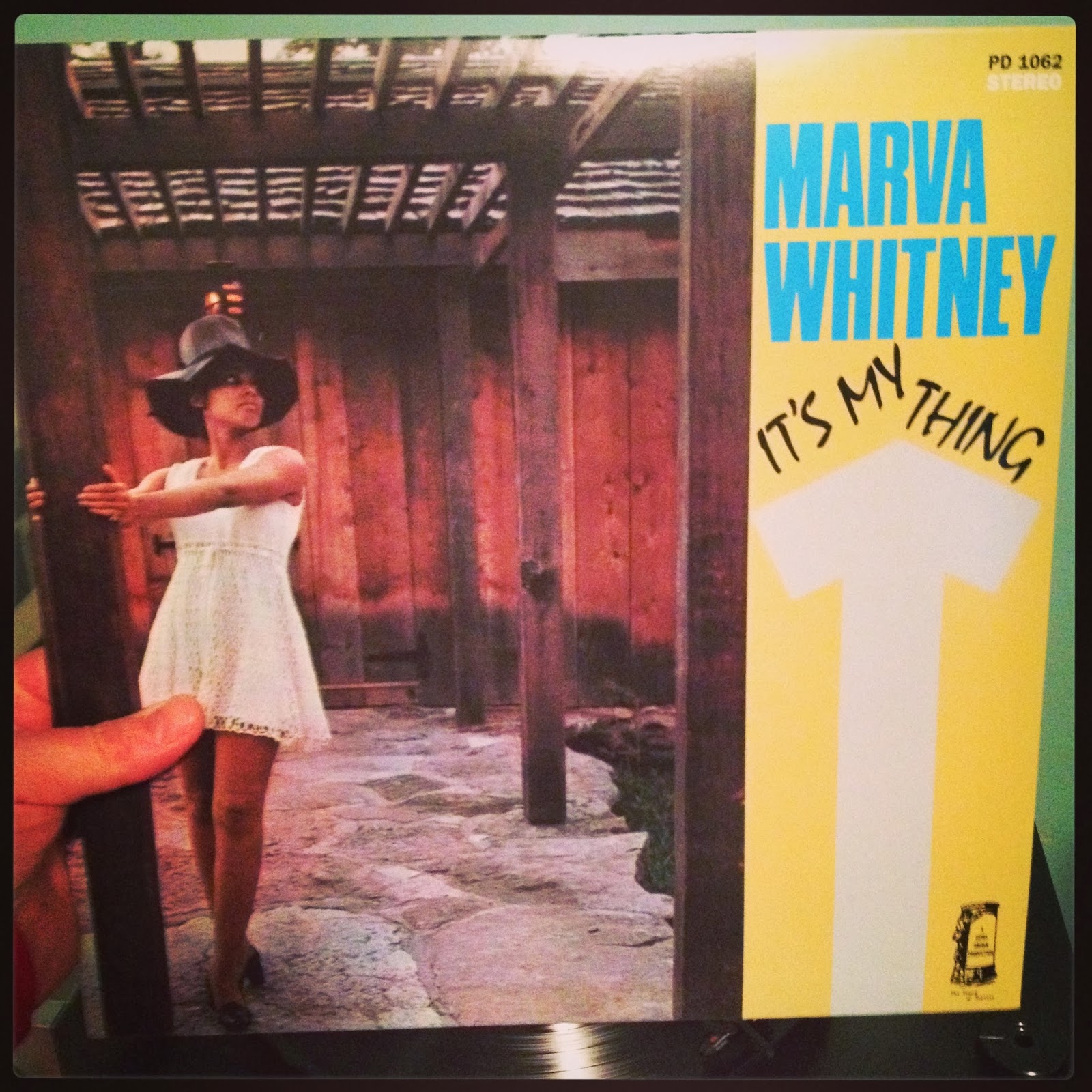
Marva Whitney It's My Thing Polydor/King 1970 (2012 Repress)

Marva Whitney It's My Thing Polydor/King 1969 (2011 Repress) CAT #PD 1062

One year ago today, Marva Whitney passed away.  She was Kansas City born and raised and started her career in KC.  She played the Kansas City scene, leading the group Tommy & the Derby's, did the Motown revue's and opened for touring artists when they passed through.  She was asked to tour with Bobby Bland and Little Richard, but turned both down opting to join the James Brown Revue as a featured vocalist as she thought it was the best move for her career.

It certainly was the best move, Brown did all he could do to make her successful as a part of his act.  During the shows, Marva Whitney would provide the audience a couple of songs while Brown rested.  He recorded her and provided her some of his best material.  There are singles cut for Federal and King while she hung with Brown.  There is also the above album, as well as live LP from the King years.  The title song of this LP, "It's My Thing (Part 1)" was released as the single, "It's My Thing (You Can't Tell Me Who To Sock It To)" and as a response to the Isley Brother's "It's Your Thing".  It represented her highest charting single.

While she never became a mainstream R&B artist, her time spent with James Brown kept her active and in front of large audiences.  The move to go with James Brown far exceeded anything she would get by backing Bobby Bland or Little Richard.  However, most say that this was among the most difficult times of her life.  When she moved back to Kansas City after her time with James Brown she told friends and family just how true the name "Hardest Working Man In Show Buisness" was.  Brown was known to work his artists relentlessly.  She had a child from her marriage to Kansas City soul singer, Harvey Whitney.  However, she was never able to spend time as a mother due to constant touring and recording.  Homesick, she left the Brown stable in 1970.

She would record some unsuccessful singles for the T-Neck label afterward.  Afterwards, she would marry Ellis Taylor, the owner and operator of Kansas City's Forte label and cut some sides.  After little success on the regional label, her recording career largely ended aside a few sporadic singles and one-off LPS.  She only briefly stopped performing and would later be a member of the J.B.'s All Stars which were a group of former Brown artists.  She didn't stop performing until 2010.

This LP represents her best work.  The material is top shelf and the players were the best in the business as they were Brown's backing band.  It is a compilation of mostly singles released for the King label, some of which we re-recorded for the LP, others that were not.  It's absurdly collectible due to it's scarcity and the fact that Whitney is one of the greatest female funk performers of all time.

The girl did not hold back, she's a screamer.  The band gets most of the attention by the collectors, the cuts have been heavily sampled throughout hip-hop, especially the track "Unwind Yourself."  But, Whitney gives these songs personality.  She's got to be the only women that could match Brown's delivery.  Further, she's got to be the only women allowed to shout out "Maceo!" when the groove needed to get deeper.  You're not going to find any ballads (well, there is "If You Love Me," but she screams that one out, too) or anything that would have played well to a white Motown crowd, this is brassy, funk, floor stompers meant for the live crowds.  There were plenty of noted soul diva's out there, but only a few funk divas like Whitney belting out tunes like this.

Unwind Yourself
It's My Thing (Live TV Performance)
You Got To Have a Job (Duet with James Brown)